Thermal paper, also known as thermal fax paper, thermal recording paper, and thermal copy paper, is called thermal copy paper in Taiwan. Thermal paper is a type of processed paper, which is manufactured by coating a layer of “thermal sensitive coating” (thermal color changing layer) on high-quality base paper. Although there are over a dozen chemicals used in this color changing layer, there are at least the following compounds: colorless dyes, which have a wide range of varieties, with fluorescent compounds being the most commonly used; Chromogenic agents account for less than 20%, commonly used being bisphenol A and p-hydroxybenzoic acid; Allergens account for less than 10%, including benzenesulfonic acid amide compounds; Filler accounts for less than 50%, commonly used being calcium carbonate (particles); Adhesive accounts for less than 10%, such as polyvinyl acetate; Stabilizers, such as benzoyl phthalate; Lubricants, etc. Therefore, the process is difficult and the technical requirements are high.
Application scope: Used as a communication medium for text and graphics on fax machines, i.e. as fax paper; Used as recording materials in medical and measurement systems, such as electrocardiogram drawings, thermal instrument recording paper, etc; Printing paper used for internet terminals; In terms of commercial activities, thermal paper is used to make trademarks, POS delivery order receipts, and common lottery tickets, supermarket receipts, hospital registration receipts, etc. Among them, the proportion of fax paper usage is the largest.
Thermal paper is specifically used for printing on thermal printers and thermal fax machines. Its quality directly affects the printing quality and storage time, and even affects the service life of printers and fax machines. At present, the quality of thermal paper on the market varies greatly, and the country has not yet issued a national standard. Many users are also unclear about how to identify the quality of thermal paper. This provides convenience for many businesses to manufacture inferior thermal paper, causing losses to users. Light products have shorter storage times, blurry handwriting, and heavy products can damage printers. Thermal printing paper is generally divided into three layers: the bottom layer is the paper base, the second layer is the thermal coating, and the third layer is the protective layer. The thermal coating or protective layer mainly affects its quality,
If the coating of thermal paper is uneven, it will cause some areas to have dark colors and some areas to have light colors during printing, resulting in a significant decrease in print quality. If the chemical formula of the thermal coating is not reasonable, it will cause the storage time of the printing paper to become very short. Good printing paper can be stored for 5 years after printing (at room temperature, avoiding direct sunlight), and now there are long-term thermal paper that can be stored for 10 years. However, if the formula of the thermal coating is not reasonable, it may only be stored for a few months.
The protective coating is also crucial for the storage time after printing. It can absorb some of the light that causes chemical reactions in the thermal coating, slow down the deterioration of the printing paper, and protect the thermal components of the printer from damage. However, if the protective coating is uneven, it will not only greatly reduce the protection of the thermal coating, but even cause small particles of the protective coating to fall off during the printing process, rubbing against the thermal components of the printer, resulting in damage to the printed thermal components.
Quality identification:
1. Appearance: If the paper is very white, it indicates that the protective coating and thermal sensitive coating of the paper are unreasonable, and too much fluorescent powder has been added. A better paper should have a slight greenish tint. If the smoothness of the paper is not high or appears uneven, it indicates that the coating on the paper is not uniform. If the paper appears to reflect strong light, it is also due to the addition of too much fluorescent powder, resulting in poor quality.
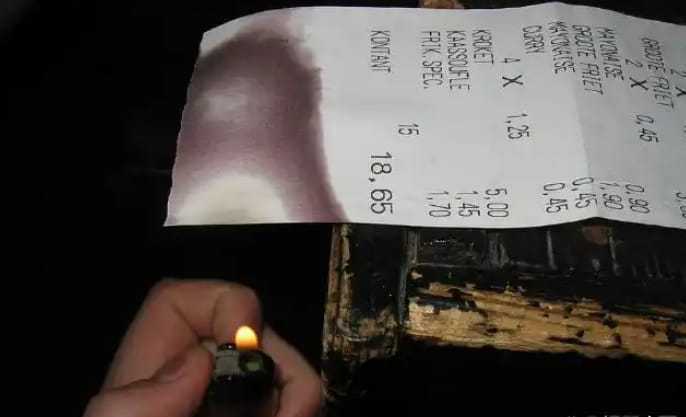
2. Fire baking: The method of fire baking is also very simple. Use a lighter to heat the back of the paper. If the color appearing on the paper after heating is brown, it indicates that the heat sensitive formula is not very reasonable and the storage time may be relatively short. If there are small stripes or uneven color blocks on the black part of the paper, it indicates that the coating is uneven. High quality paper should be black green (with a hint of green) after heating, and the color blocks should be uniform, gradually fading from the center to the surrounding areas.
3. Comparison and identification of sunlight exposure: After applying a fluorescent pen to the printed paper, place it in the sun to accelerate the reaction of the thermosensitive coating to light. Which type of paper turns black the fastest indicates a shorter shelf life.